
In one week, on March 17 at 6:00 pm ET, Florida plans to execute Michael King.
Before I explain more about his case, I want to give you the opportunity to take action now:
- If the execution proceeds, please join us outside the prison, online, or at one of the many events across the state
- Add your name to Michael’s petition
- Send a message to Governor DeSantis
The murder of Denise Amber Lee marked a profound and irreversible loss. We empathize with the pain and grief felt by her loved ones. In the wake of this unimaginable tragedy, Denise’s legacy has inspired significant reforms that have strengthened emergency communication systems across Florida and beyond, ensuring that her story continues to resonate and contribute to improvements in public safety.
But even in cases involving profound loss, the law still requires that punishment be imposed reliably, proportionately, and constitutionally. Serious questions remain about whether that standard has been met.
When he was six years old, Michael suffered a severe head injury in a sledding accident. The sled he was riding slammed into a wooden post, and his face and frontal lobe struck the beam directly, knocking him unconscious. He was carried home bleeding from his head, nose, and mouth while his family tried to keep him awake so he would not slip into a coma.
After that accident, his life changed.
Michael began experiencing chronic nosebleeds, hallucinations, severe anxiety, and significant struggles in school. Family members described drastic behavioral changes following the injury. Neuropsychological testing later revealed structural abnormalities in his frontal lobe — the region responsible for impulse control, reasoning, and the ability to weigh consequences.
But the full scope of this neurological damage was never adequately investigated or presented to the jury that decided whether Michael should live or die.
Michael has spent nearly two decades on death row. During that time, he has maintained steady behavior inside the prison and worked performing plumbing and maintenance tasks that assist others in the institution. He has also developed a deep religious faith that has become central to his life. For years, his spiritual advisor has visited him weekly. Michael studies scripture, attends religious services, and participates in prison ministry. Those who know him describe a man capable of reflection, remorse, and transformation.
Serious concerns about Florida’s execution process continue
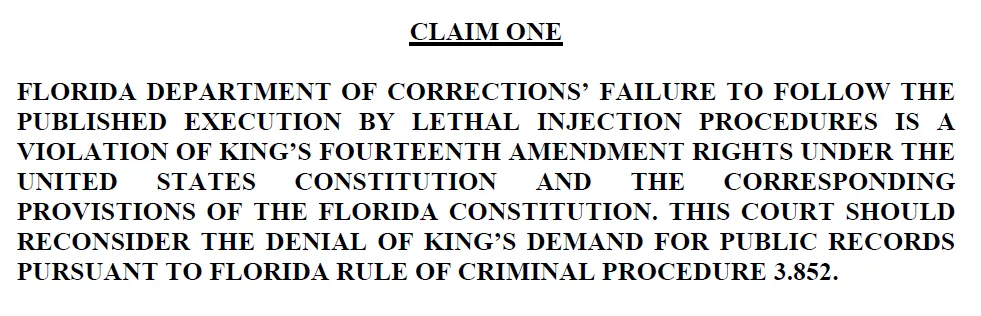
Michael’s lawyers continue to ring the alarm bell that’s been ringing for 103 days: The Florida Department of Corrections is deviating from its own lethal injection protocol and people are being tormented unnecessarily because of it.
Particularly relevant for Michael’s case, records from prior executions involving similarly situated defendants show troubling deviations from the written protocol. During the execution of Thomas Gudinas, the State prepared only about 50% of the required dose of the paralytic drug, and during the execution of Anthony Wainwright, the State prepared only about 58% of the drug used to induce cardiac arrest.
We’ve seen these deviations play out in recent executions. It took the State 20 minutes to execute Bryan Jennings last November and 24 minutes to execute Billy Kearse a week ago — both twice as long as it normally takes if we could call anything about lethal injection “normal”.
Execution is irreversible. Constitutional violations should not be.
Onward,
Bridget Maloney
FADP Communications Director
P.S. James Duckett’s DNA testing is currently in progress. You can read more about that in today’s article from the Tampa Bay Times. Please also take a moment to sign his petition.